
Book review
How to Stop Manifesting and Start Becoming

Have you ever reached a point where trying harder stopped working? Think at more effort, more thinking, and more control.
But somehow, the results moved further away instead of closer.
After reading The Frame earlier, where authors Justin Michael and Jonny Staker explored power, status, and influence through the concept of being, Justin’s new book takes that idea one step further – into a space that millions of readers believe they already understand:
The Law of Attraction. Or more precisely, why it never quite worked the way we were told.
From Frame to Identity
If The Frame was about how presence shapes influence, this new book is about something even deeper: How identity shapes reality.
Justin challenges one of the most widely accepted ideas in modern self-development – that thoughts create reality.
Instead, he introduces a shift that feels simple on the surface but lands with force:
- Not thoughts → results.
- But identity → everything.
This is not a refinement of manifestation; it is a reordering of it.
The hidden problem behind manifestation
For decades, readers have been taught to:
- visualise outcomes
- repeat affirmations
- maintain positive emotions
- “raise their vibration”
And sometimes, it works (I use it for book writing for years).
But as Justin describes, something eventually breaks as the effort increases, the tension builds, and the outcomes feel forced.
This book addresses that uncomfortable gap and explains why the more people try to control reality, the more resistance they often create – and why that resistance quietly undermines the very outcomes they seek.
Forcing vs. becoming
At the heart of the book sits a clear distinction: manufactured manifestation vs. becoming.
The first relies on effort, techniques, and control. The second relies on identity.
Justin reframes the entire process:
- Being shapes thinking
- Thinking shapes action
- Action shapes results
Most approaches try to fix the middle but Justin’s new book moves upstream.
Once you see that shift by yourself, it becomes difficult to look at manifestation the same way again.
A short book with a deep shift
Unlike many books in this space, Rewriting the Law of Attraction is intentionally short. You can read it in one sitting as I did first.
See it more as a philosophical correction – a provocation that invites the reader to question something widely accepted.
Each of the 13 chapters ends with a short ritual as a doorway into awareness, not a hardcore homework to move to the next chapter.
This approach aligns perfectly with Justin’s writing style already visible in The Frame and some of his earlier books: short sentences, minimal explanation, maximum impact.
Real life adaptability
What makes this book interesting is how quickly it reframes everyday experiences – regardless whether you agree with every argument.
After reading, you begin to notice patterns such as:
- why forcing outcomes creates tension
- why some opportunities appear without effort
- why identity shifts often precede major life changes
- why trying harder sometimes weakens your own position
For readers in business, sales, leadership or creative work, this becomes especially relevant because the idea of “signal” (what you emit through your identity) directly connects to how others respond to you.
Knowing Justin for his sales books, I see this book as the fundamental underlying layer he was finally ready to write.
Useful quotes out of the book
While reading this book I stopped quite often as some sentences directly jumped out of the book to stand for by themselves. Here are some of my favourite examples:
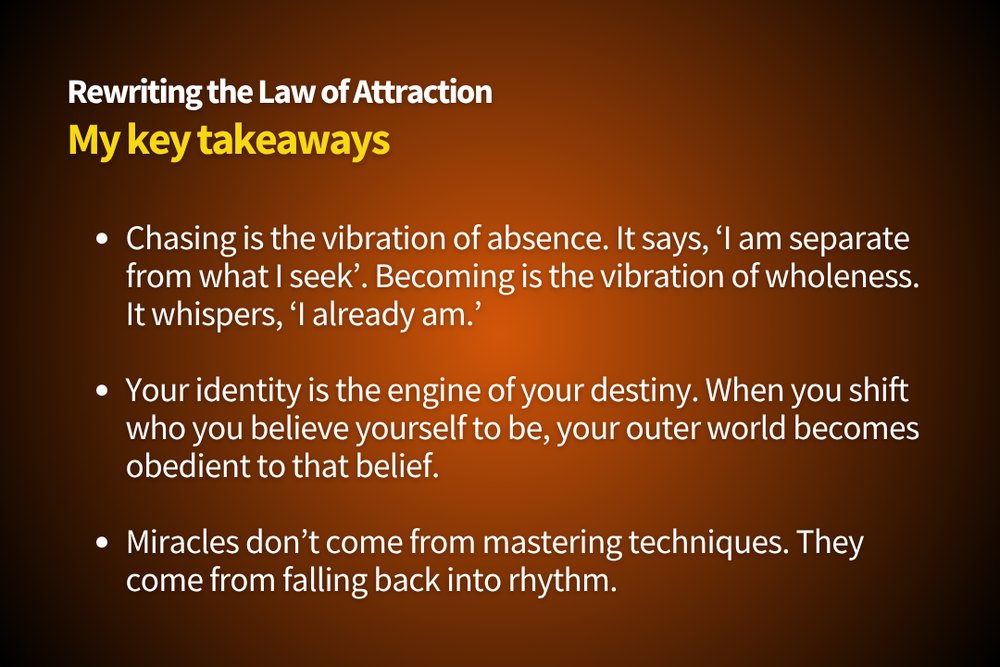
- Chasing is the vibration of absence. It says, ‘I am separate from what I seek’. Becoming is the vibration of wholeness. It whispers, ‘I already am.’
- Your identity is the engine of your destiny. When you shift who you believe yourself to be, your outer world becomes obedient to that belief.
- Miracles don’t come from mastering techniques. They come from falling back into rhythm.
As in his earlier books, memorably sentences are short to work also outside the intended context.
Inspiration for fellow writers
From a writing perspective, this book follows a very specific approach: It creates impact through clarity without trying to convince through length.
Justin deliberately keeps the book short, almost like a long-form essay which could easily be an article series on Substack. Once the core idea becomes visible, repetition becomes unnecessary.
When I read an early version, I have been stunned by an element rarely found in books: rhythm.
A powerful reminder for every author: Not every book needs to explain everything. Some books only need to reveal one mechanism clearly enough so that the reader can do the rest for their own situation.
Final verdict
This is not a traditional manifestation book as it does not give more techniques to apply. It even removes the need for many of them.
By shifting the focus from thinking to being, Justin Michael challenges one of the most popular ideas in modern self-development – and replaces it with something both simpler and more demanding.
Because if identity is the real driver, then outcomes are no longer something to chase. Instead they become something to grow into. Once you start seeing life through that lens, it is difficult to return to the old model.
Just like with The Frame, this book doesn’t just offer ideas. It changes how you observe what’s already happening.
In conversation
Q&A with Justin Michael
1. What was the deciding moment to write this book?
I was deep into writing The Frame, and every time I touched anything spiritual, it got cut. It didn’t fit the structure, but it wouldn’t leave me alone. That tension forced me deeper into ontology, the science of being. Around the same time, I was absorbing The Surrender Experiment and the distinction between surrendered and manufactured manifestation. That insight broke something open. It showed me there was a deeper law underneath everything, not attraction, but becoming.
I wrote the first version in a single weekend. It felt less like writing and more like uncovering something that was already there. The original title was Phoenix Rising: The Hidden Law of Becoming. But then I had a realization that changed everything. There are hundreds of millions of Law of Attraction books in the world, and not one directly challenges the premise. That’s when it shifted from a book into a position.
A call with Mark Victor Hansen sealed it. He said, “Drop Phoenix Rising. Call it what it is: Rewriting the Law of Attraction.”
That was the moment it became dangerous. And that’s when I knew it would work.
2. How long did it take from concept to launch?
It looks simple. It isn’t. The book is only about 17,000 words, but it took around 100 focused hours to get right. The difficulty wasn’t writing. It was restraint. Every sentence had to carry weight without force.
I had it edited in England by Rebekah Carter to ensure it breathed properly. No excess. No noise. Just signal. Every decision, structure, flow, even the practices at the end of each chapter, was built around one principle: surrender.
What started as exercises became rituals designed to dissolve identity. The phoenix remained, but it stopped being symbolic and became experiential. I grounded it in my own ego death and three extinction level events that shaped the message.
I also wrote it with a very specific intention. It had to work in one sitting but still matter in 100 years. That meant stripping it down to something timeless. Not tactics. Not trends. Something fundamental.
3. How did you perform the research to create the practical content?
This wasn’t research. It was a 20-year obsession. It started in 2006 after meeting Jack Canfield, which led to time with Rhonda Byrne and exposure to the original Law of Attraction lineage. From there, I went deep. Wallace Wattles, Neville Goddard, James Allen, Maxwell Maltz, Byron Katie, Joe Dispenza, Syd Banks. Not casually. Repetition. Integration. Application.
But the real work happened in the field. Over 1,000 clients. High performers, founders, executives. Testing what actually creates change versus what sounds good. I built my own framework, Musifestation, rooted in solfeggio frequencies and visualization, and supported it with neuroscience and quantum mechanics where useful.
The pattern became undeniable. People don’t fail because they think wrong. They fail because they are being someone who cannot hold the outcome. Once identity shifts, everything else reorganizes. Thought follows. Action follows. Results follow.
That’s when I knew this wasn’t another mindset book. It was a correction.
4. What was the biggest challenge along the process (and how did you overcome it)?
The hardest part was exposure. Not intellectually. Personally. I had to put my real life into the book. My father’s bankruptcy and incarceration. Losing custody of my daughter. Addiction. Things most people hide or soften.
But I realized something. If I diluted the truth, I would dilute the impact. And this work only works if it’s real. So I made the decision to tell it clean. No protection. No positioning.
The second challenge was even bigger. Challenging the Law of Attraction itself. When you question something millions of people believe in, you create immediate polarity. Some people feel instant clarity. Others reject it instantly.
That’s how you know you’ve hit something real. Neutral ideas don’t spread. Truth divides before it unifies.
And underneath all of it, the core lands. Surrender. Faith. Letting go. Reinvention. These are not opinions. They are human necessities.
5. What was your own reflection along the journey?
The most surprising part was the emotional response. I hit Chapter 7 during editing and stopped. It got me. Then I started hearing the same thing from readers. People don’t just read it. They experience it.
Personally, I’ve shifted. More surrender. More awareness of synchronicity. Less force. More trust. What I call pronoia, the quiet sense that things are working for you, not against you.
But the real reflection came from the data. People read it in one sitting. Then they read it again. And again. That’s when it became clear. This is different. This is my first true breakout book.
It’s my tenth public release. The eleventh I’ve written in a decade. And the first that creates an immediate internal shift.
The lesson is simple. Never give up. The most powerful ideas are almost always the simplest. This is a reframe you cannot unsee once it lands. It takes minutes to understand and years to fully live.
And one more realization. Writing is a small part of it. Maybe 20 percent. The other 80 percent is distribution. Getting it into the hands of people who are ready.
So now the mission is singular. Scale it. Relentlessly.
6. What is the outcome in having this book available?
People are changing fast. Not gradually. Immediately. I’ve had people tell me decades of internal patterns started collapsing after a single read.
This is also the first book I’ve written that isn’t confined to business or sales. It applies to anyone. That’s expanding everything. Audience, reach, perception. People are seeing that the work underneath what I do is much deeper than tactics.
It’s also creating a movement. Because millions of people have tried to think their way into results and quietly failed. This gives them a different path. One that doesn’t require force.
And when something works without force, it spreads.
7. What would you advise others about writing their book?
Start with one idea. Not ten. One. Something clear, undeniable, and expandable. The best books are built on a single core truth explored from multiple angles.
Keep it short. People don’t want more information. They want something that hits. Something they can finish in one sitting and carry with them.
Put your life into it. Not as decoration, but as proof. If it didn’t happen to you, it won’t land for them.
Test it early. I had hundreds of readers shaping this before it was finished. I crowdsourced feedback, iterated constantly, even tested design direction. The crowd will tell you what resonates if you know how to listen.
And if you have a radical perspective on something widely accepted, don’t soften it. That tension is the book.
Because when it works, it doesn’t just get read. It moves.
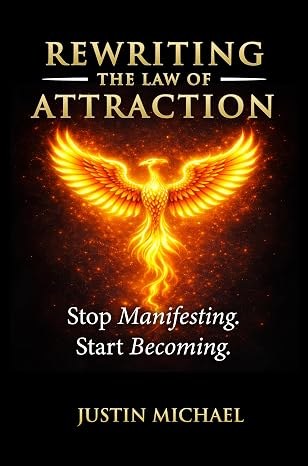
Justin Michael: “Rewriting the Law of Attraction”, Jones Media Publishing 2026, ISBN 979-8-25184102-2 (Paperback) or ASIN B0GSBYCGXZ (Kindle eBook).More about the book: newbecoming.com
Also published on Medium
Writing a book of your own?
Every review here ends with what other authors can learn from it. If you want that thinking applied to your own book, let’s talk it through.
Book a strategy call